

How To Repair Blower Motor Resistor
Blower motor, resistor: how it works, symptoms, problems, testing
Updated: August 01, 2022
The motor that runs the fan in the heating and air-conditioning system in a car is called a blower motor. It's located within the nuance, often on the opposite side of the steering bike or inside the engine compartment on the firewall. A blower motor resistor or a blower motor control module is the part that controls the speed of the blower motor.
What is the difference? A blower motor resistor is a uncomplicated electric resistor. It's used in cars where the blower motor has only 4 or 5 fixed speeds, as on the left side in this diagram. See the photo of the Ford blower motor resistor.
Cars with an automated climate control organisation and vehicles where the blower speed can be adapted gradually are equipped with an electronic blower motor control module, run into the photo.
In almost modern cars, the blower motor resistor or the control module are installed within one of the ducts in the HVAC system, close to the blower motor. This is done, then the resistor or a command module is cooled downwardly by passing air. In some older cars, a blower motor resistor was installed on the firewall with access from nether the hood.
Blower motor resistor / control module problems
Problems with a blower motor resistor are common in many cars. The about common symptom of a failed blower motor resistor is when the heater fan only runs at the highest speed setting (4 or 5) and doesn't work at low speeds. In some cars, a failed blower motor resistor can crusade a heater fan to finish working completely.
In most cases, a blower motor resistor fails due to corrosion or overheating. Sometimes, the mechanical resistance to the motor rotation causes an excessive electrical electric current that can overheat and prematurely damage the blower motor resistor. For case, this happens when the fan bract is jammed by a strange object or when the motor bearings are worn out and information technology doesn't spin freely.
Problems with a blower motor control module are less frequent, simply it fails for the same reason: due to corrosion or overheating when the motor is jammed or shorted. In most cases when a blower control module fails, the blower motor doesn't work at all. In some cars (east.g., older GM trucks), a failed blower control module or processor can crusade the blower motor to continue running fifty-fifty with the ignition OFF.
How is the blower motor resistor diagnosed?
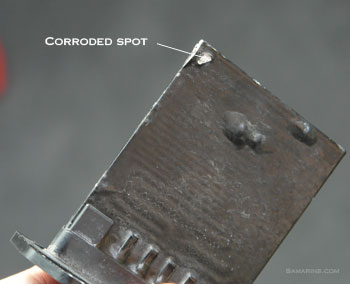 This Ford blower motor resistor has failed due to corrosion
Diagnostic procedures vary. Often a visual inspection of the resistor reveals the trouble. For example, equally yous can see in this photograph, the blower motor resistor in this Ford Escape has failed due to corrosion.
If the resistor shows no visual impairment, the resistance between terminals must be checked and compared to specifications. If the resistance is out of specs, the resistor must be replaced.
For example, in this photo nosotros measured the resistance of this blower motor resistor. According to the service manual, it must be around four-5 ohms.
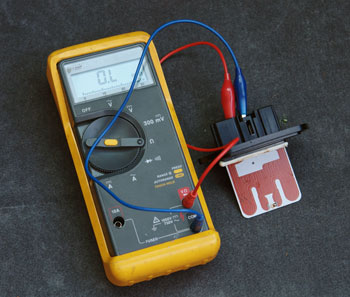 Failed resistor tested with an ohm-meter
In our case the ohmmeter shows open circuit, which means the resistor has failed.
Sometimes, a blower motor resistor might fail due to bug with the blower motor itself. This means after replacing the blower motor resistor, check if the blower motor runs freely and doesn't make any noise. We have seen instances where a worn-out blower motor causes a recently replaced resistor to fail again. For example, this outcome was common in older Chrysler and Dodge minivans. In this case, the blower motor must likewise be replaced. Ane of the symptoms of a worn out blower motor is that it tin can intermittently produce a loud screeching noise when running.
How to test the blower motor?
If the blower motor doesn't piece of work at all, the blower motor itself must be tested first. Typically it'south done by measuring the voltage at the blower motor connector when it'due south turned on. If there is a voltage at the motor (at to the lowest degree 4-6 Volt at low speed and 12 Volt at high speed), but the motor doesn't run, the motor is bad or jammed.
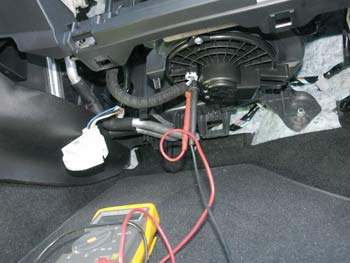 Testing the voltage at the blower motor. If there is a voltage at the motor (at least 4-half-dozen Volt at depression speed and 12 Volt at loftier speed), but the motor doesn't run, the motor is bad.
Things like leaves, twigs, nuts, pieces of a ripped cabin filter tin can jam the blade of the blower motor. This happens often in many cars.
If at that place is no voltage at the motor, the entire blower motor circuit must be tested, starting from a fuse. Run across: how to check a fuse in a car.
If a blower motor is bad, it will demand to be replaced. The blower motor replacement costs from $320 to $650, depending on the car. In many cars it's adequately easy; the blower motor is located behind the glove box and held by iii-4 screws. In others it might be located inside the nuance (e.grand. Mazda 5) which makes replacement difficult.
If you need a proper diagnostic process, we have posted several links where yous can access a service manual for your car for a subscription fee. Bank check this post, scroll down the folio.
How is the blower motor control module tested?
Mechanics at a dealership can diagnose the HVAC organisation with a scan tool. If the scan tool is not bachelor, in many cars with an automatic climate control system at that place is a self-testing or diagnostic mode.
Typically it can be activated by pressing and holding unlike buttons. For example, in the 2009 Honda Accordance, the service manual describes the procedure as follows: Turn the ignition to ON. Press and hold the OFF button and within 10 seconds press and release the Window Defogger button five times. The system enters the cocky-diagnostic mode and at the cease of it, if there is a problem, the fault lawmaking will be displayed on the display. The service transmission describes the testing procedure for each code. Meet, for example, these YouTube videos; add make and model of your vehicle.
Another mode is to bank check the voltage at the blower motor, the blower motor control module and other parts of the circuit according to the service manual. For example, in the mentioned 2009 Honda Accordance, the + 12V power is supplied direct to the blower motor through the fuse and so through the relay.
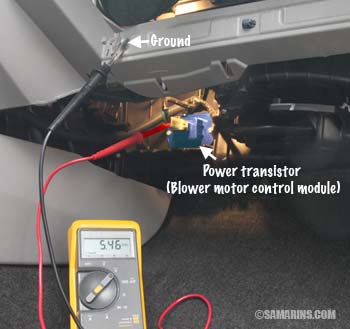 Testing Honda power transistor (blower motor control module).
The blower motor control module (Honda calls information technology Power Transistor) supplies the ground. The power transistor has 4 wires: ii come from the climate control system control unit, i is the ground, one goes to the negative terminal of the blower motor. The service manual advises measuring the voltage at the blower motor, then if not OK, at the power transistor and so on.
A failed power transistor was a fairly common cause for not working blower motor in some Honda and Acura vehicles. For instance, the Honda bulletin 03-048 described a problem where the blower motor for the rear HVAC system in the 2003 Pilot would not work at all speeds.
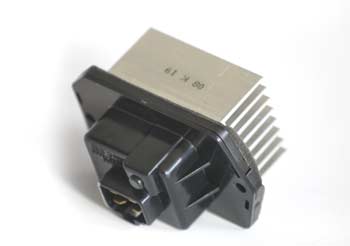 Honda blower motor control module (power transistor)
The bulletin recommends replacing the rear power transistor as a solution.
BMW calls the blower motor control module a Concluding Phase Unit, which is also fairly mutual to fail. Sometimes it doesn't fail completely, but causes the blower motor to stop working intermittently or run at various speeds. Encounter these YouTube videos for more than info.
In some GM trucks, a blower motor control module failure can cause the front end blower motor to stop working or run after the vehicle has been shut off. The GM bulletin 06-01-39-002C describes this problem that happens in cold conditions. The bulletin advises replacing the blower motor control module. GM calls it Linear Power Module (LPM). Sentry these YouTube videos for more info.
Repair options
Your local mechanic or whatsoever small repair shop should be able to diagnose the trouble. Of grade, the quickest style is to make an engagement with your dealer. Many dealers have the role in stock. The blower motor resistor or command module replacement is not very expensive.
For example, one of our colleagues had a problem with his 2022 Ford Escape: the fan only worked at the speed 4. He paid $50 to diagnose and $112 to replace the resistor at a local Ford dealership. When the same problem occurred 2 years later, he ordered the role online for $25 and replaced information technology himself.
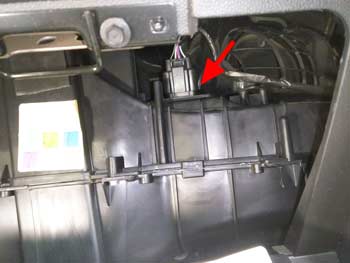 In the 2008-2011 Ford Escape / Mazda Tribute, the blower motor resistor is located on acme of the HVAC unit, behind the glove box.
In the 2008-2011 Ford Escape, the resistor is located behind the glove box on top of the HVAC unit air duct. Information technology's held by two screws and is easy to replace. See the photo.
In the 2008-2011 Ford F150, the blower motor resistor is likewise located behind the glove box, simply is installed on the right side of the plastic air duct. This thread at f150online.com shows where the resistor is located.
The author of this weblog shared his experience of replacing the blower motor resistor in Jeep Freedom. In some older cars and trucks, the blower motor resistor is installed on the firewall, with access from under the hood.
How the blower motor resistor works
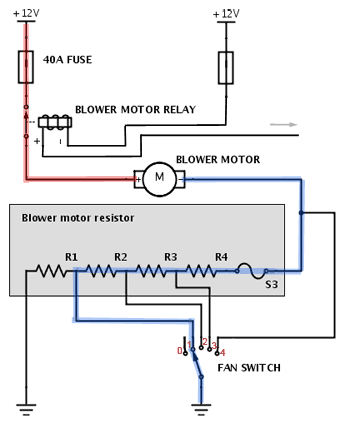 Typical blower resistor diagram
This diagram shows how the blower motor resistor is connected in a typical automobile. In this machine, in the highest "four" fan speed setting, the resistor is bypassed and the blower motor is powered directly past the fan switch. That's why in some cars, the blower motor may still piece of work in the "High" speed setting if the resistor is bad.
In this diagram, the fan switch is set to the speed "1", so the blower motor current is reduced by three resistors (R2 + R3 + R4) connected in series. The current menstruum is shown in blueish and blood-red.
In the setting "two", there are ii resistors connected in serial, and in "3", in that location is but ane resistor.
Adding resistance to the electrical excursion reduces the current in the circuit. When several resistors are connected in series, the full resistance increases and is equal to the sum of individual resistances.
Source: https://www.samarins.com/glossary/blower-motor-resistor.html
0 Response to "How To Repair Blower Motor Resistor"
Post a Comment